Quick Summary
Structured toddler gymnastics and general kids’ activities serve different developmental purposes at ages 2.5 to 3.5. Purpose-built equipment, coached movement sequences, and an environment designed around toddler-sized bodies create physical and cognitive outcomes that unstructured play cannot replicate. Children in Tiny Tots classes develop balance, focus, spatial awareness, and early independence, all while building the behavioral foundations that prepare them for school and beyond.What Tiny Tots Gymnastics in Queens Looks Like
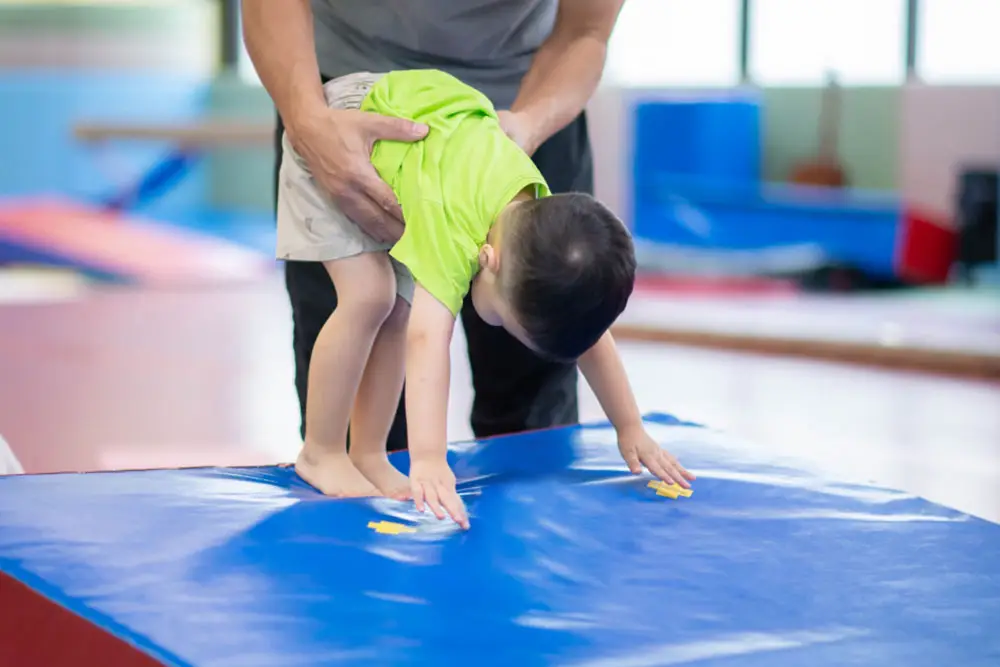
Before getting into the developmental case, it helps to understand what a Tiny Tots class is in practice. Our Tiny Tots gymnastics program runs 45 minutes and is designed specifically for children ages 2.5 to 3.5. Classes take place in our Kinder Gym, a dedicated space equipped with colorful, soft, multi-shaped mats and apparatus scaled to young bodies. Children move through gymnastics activities, including balance beams, trampolines, climbing ropes, rings, and foam shapes under the guidance of experienced coaches and set to children’s music. This is not open play with a mat on the floor. It has direction, sequence, and purpose. A coach leads the session, introduces movement concepts through games and imaginative exercises, and guides children through an age-appropriate progression of physical activities.The Age Window That Changes Everything
Children between 2.5 and 3.5 are in one of the most active periods of physical development in their lives. Gross motor skills are forming rapidly. Balance, bilateral coordination, spatial awareness, and the ability to control movement are all developing at a pace that won’t be matched again. This is the window where movement-based experiences have an outsized impact. A playgroup or storytime session has social interaction, language development, and sensory engagement. Yet, it doesn’t intentionally put physical challenge in front of a child the way a gymnastics class does. Rolling, jumping, climbing, landing, and balancing on equipment are not things toddlers encounter in a typical Tuesday morning at the park. They require a purpose-built environment and a coach who knows how to deliver them safely. At this age, we find that children are also beginning to respond to group instruction. A 2.5-year-old can follow a simple direction. A 3-year-old can watch a demonstration and attempt to replicate it. A gymnastics class harnesses this developmental readiness and channels it into physical learning.Equipment Built for Toddler Bodies
One of the clearest practical differences between a gymnastics class and other toddler activities is the equipment. Standard gym apparatus is designed for older children and adults. A toddler handling equipment that doesn’t match their size or strength is just struggling and potentially at risk. Our Lana’s gymnastics programs use toddler-scaled, soft, multi-shaped apparatus in a purpose-designed environment. Low balance beams sit close to the ground. Mats are thick, padded, and shaped for young bodies to move across safely. Trampolines are small and supervised. Climbing ropes and rings are positioned at heights that challenge without intimidating. This matters because the right equipment creates the right experience. A toddler who can reach a bar, step onto a beam without fear, or roll across a soft mat with confidence is developing. The physical environment has to match the developmental stage, and that’s a level of specificity that a general recreational class simply doesn’t provide.Coached Movement vs. Free Play
Free play is important and has a firm place in early childhood, and nobody is arguing against it. Still, free play does not teach a child how to move with intention, how to sequence a physical task, or how to try something that feels uncertain and work through it with a coach’s encouragement beside them. A Tiny Tots gymnastics class does all of these things. Here’s what a structured session typically involves:- Warm-up with movement and music to orient children to the class environment:
- Balance and coordination activities using beams, mats, and foam shapes:
- Climbing and upper body engagement on ropes and rings:
- Trampoline work to develop jump mechanics and body awareness:
- Cool-down and simple group activities to build listening and turn-taking:
What Children Take Away
Parents often notice the physical changes first. Better balance, more body awareness, and a child who falls and knows how to get back up. These are visible outcomes of consistent gymnastics classes at this age. The less visible gains take slightly longer to see, but they’re just as meaningful. Children who attend structured gymnastics classes from 2.5 to 3.5 are practicing focus in a physical context. They are learning to wait their turn, watch a demonstration, and attempt something new without a parent holding their hand through every step. They are building the early independence and group-behavior skills that a classroom will eventually require of them.A Natural Starting Point for a Longer Journey
Tiny Tots is not a standalone class. It is the beginning of a pathway. Children who start at 2.5 to 3.5 have a natural progression into our Preschool Gymnastics program for ages 3.5 to 5, and from there into recreational girls or boys gymnastics and, for some, the competitive team. Families who join us at the Tiny Tots stage stay with the same coaches, community, and facility as their child grows. There is no need to switch gyms, restart relationships, or find a new program. This continuity is something parents often tell us they didn’t expect to value as much as they do. A child who grows up in one gym, with familiar coaches who know their name and their pace, develops in a very different environment from a child who cycles through new programs.Is Your Toddler Ready to Start?
The short answer is that if your child is between 2.5 and 3.5 and has enough coordination to walk steadily and respond to simple directions, they are likely ready for a Tiny Tots class. The class is designed to meet children where they are and move them forward from that point. What they do need is a safe space, age-appropriate equipment, and a coach who knows how to make movement feel like play. The rest takes care of itself.Take the First Step With Your Toddler
Choosing an activity for a 2.5 or 3-year-old is one of the earliest parenting decisions that actually shapes development in a lasting way. A structured gymnastics class at this age puts intentional physical challenge, skilled coaching, and a community of peers into the same 45-minute session, week after week. If you’d like to learn more about what our Tiny Tots program looks like or how to get your child started, reach out to us, and we’ll walk you through everything.FAQs
Do parents stay in the room during Tiny Tots gymnastics classes?
Tiny Tots classes at this age are designed to foster early independence. Coaches guide children through the full session, and the structured environment gives toddlers the security they need to participate without a parent on the floor beside them.
How soon will I notice a difference after my child starts Tiny Tots classes?
Progress timelines vary by child, but parents often notice improvements in balance, body awareness, and listening within the first several weeks. Physical confidence tends to develop gradually and becomes more visible as children grow comfortable with the equipment and routine.
What should my toddler wear to a Tiny Tots gymnastics class?
Comfortable, fitted athletic clothing works well. Bare feet are standard in gymnastics, so socks with grip or no socks at all are appropriate. Avoid loose clothing or accessories that could catch on equipment during movement activities.