Quick Summary
A trial class tells you far more about a gym than any website or brochure ever could. Watching how a coach talks to kids, corrects mistakes, and manages a room full of energy reveals the true quality of a program within thirty minutes. Parents who know what to look for during this one class can make a far more informed decision than those relying on price or location alone.
Signing up for a gymnastics trial class is one of the smartest steps a parent can take before committing to a program. The trick is knowing what to watch for once you are sitting in that viewing area, since a class can look busy and fun on the surface while missing the deeper qualities that make a coach genuinely effective.
Watch How the Coach Talks to Kids
Pay attention to tone and word choice from the very first minute. A strong coach speaks directly to children in clear, simple language and adjusts that language based on age. A coach working with four-year-olds should sound different than one working with a ten-year-old competitive gymnast. Listen for encouragement that feels specific, such as pointing out exactly what a child did well, rather than generic praise repeated for every student.
Watch for patience too. A coach who stays calm when a child struggles or acts out, redirecting behavior without frustration, shows the kind of temperament that keeps kids feeling safe and supported over the long run.
Notice How Corrections Are Given
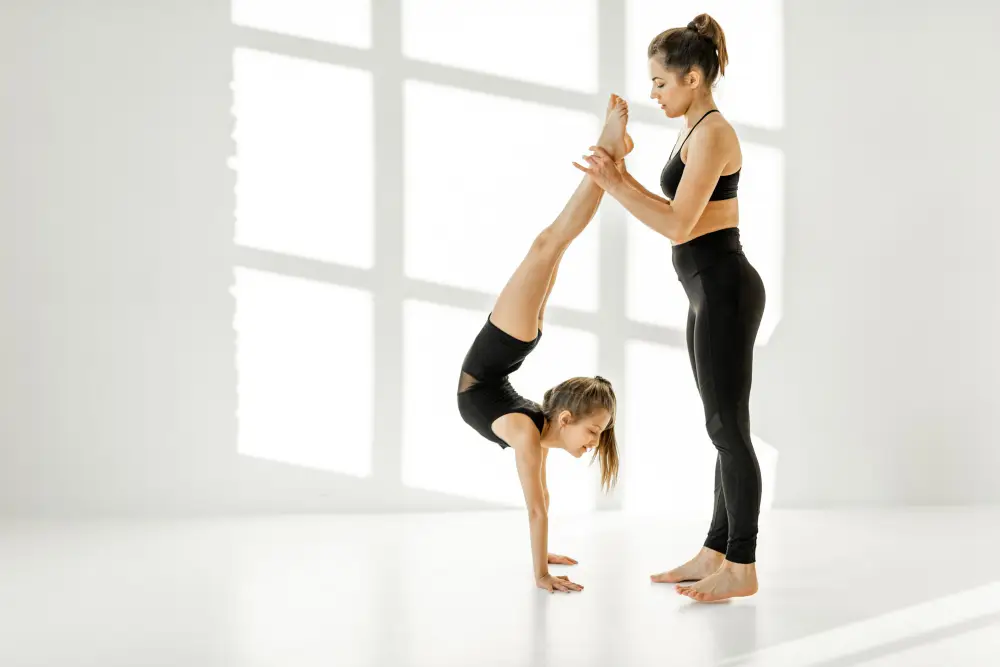
Every child makes mistakes during a class, and how a coach responds says a great deal about their skill. Strong gymnastics coaches break a skill into smaller pieces when a child struggles, rather than repeating the same instruction louder. They demonstrate the correct form themselves or use a spotting technique to help a child feel the right movement in their body.
Weaker coaching often looks like a single correction repeated without adjustment, or worse, no correction at all while a child practices a skill incorrectly. Left uncorrected, small errors tend to turn into habits that are much harder to fix later.
Look at Class Management and Waiting Time
A well-run class keeps kids moving and engaged, with minimal standing around waiting for a turn. Coaches who manage stations well, rotate groups efficiently, and keep instructions short maintain energy and attention throughout the session. Long stretches of idle waiting often signal a class that is understaffed or poorly structured for its group size.
Watch how the coach handles transitions between activities as well. Smooth, quick transitions suggest a program that has built strong routines, while chaotic or slow transitions can point to bigger structural issues.
Check for Individual Attention
Even in a group setting, a good coach finds moments to give individual feedback to each child during the class. Watch to see if the same one or two kids get most of the attention, or if the coach circulates and checks in with everyone.
This detail becomes especially important in larger classes, where individual correction can easily slip through the cracks without a coach who prioritizes it.
Look for Safety and Pacing
Good coaching also shows up in the small, quiet decisions a coach makes throughout class. Spotting a child on a new skill, adjusting the height of equipment for a younger group, or slowing the pace when energy runs high are all signs of a coach thinking several steps ahead rather than simply running through a checklist. Safety habits like clearing mats before a rotation or checking grip before a child mounts the bars often happen so smoothly that parents barely notice them, yet they play a huge role in preventing injury.
Pacing tells its own story too. A gymnastics class that moves too fast can leave kids feeling rushed and unsure of their footing, while one that drags loses attention fast. The best coaches read the room and adjust in real time, speeding up when kids are locked in and slowing down when a skill needs more repetition to click.
What to Ask After the Class
Once the trial ends, a few questions can round out what you observed:
- How does the gym track a child’s progress over time?
- What does the path from this class to the next level look like?
- How are coaches trained and evaluated?
- What safety measures are in place during skill practice?
See Good Coaching in Action at Lana’s Gymnastics Club
At Lana’s Gymnastics Club, we invite every family to book a gymnastics trial class and see our coaching approach firsthand. Our coaches bring decades of hands-on experience and know how to balance encouragement, clear correction, and genuine patience in every session.
We keep classes structured and engaging, with real attention given to each child rather than a one-size-fits-all approach. With over 30 years serving Queens families and a facility built specifically for gymnastics, we have refined what good coaching looks like across every age group we serve. Book a trial class today and watch for yourself what sets real coaching apart.
FAQs
What age is best for a first trial class?
Most gyms welcome trial classes for children as young as 2, with age-specific groups for every stage.
How long does a typical trial class last?
Trial classes usually run the same length as a regular class, often between 45 minutes and an hour.
Should I stay to watch, or drop my child off?
Most gyms allow parents to observe from a viewing area, which gives a clearer look at coaching quality.
What if my child seems unsure during the trial?
A little hesitation is normal. Watch how the coach responds, since gentle encouragement is a good sign of strong coaching.